
In mining, quarrying, cement, metallurgy, and coal handling, the first few meters of material movement are often the most brutal. Run-of-mine ore, limestone, clinker, coal, or overburden may fall directly from trucks, crushers, hoppers, or stockpiles with tremendous weight and impact force. This is where a heavy duty apron feeder earns its place.
Unlike light belt feeders, an apron feeder is built to receive shock, carry dense bulk material, and deliver it at a controlled rate. Its job is not simply to move material forward. It must absorb impact, regulate flow, protect downstream equipment, and keep production stable under conditions that are abrasive, hot, oversized, wet, sticky, or unpredictable.
What a Heavy Duty Apron Feeder Does
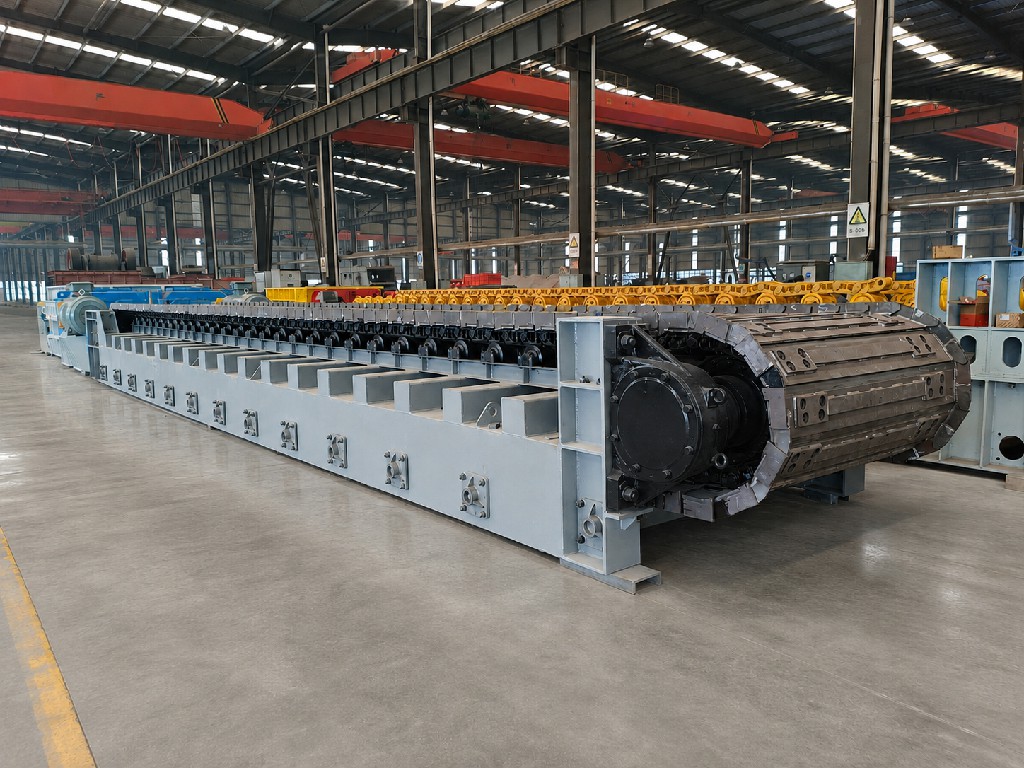
A heavy duty apron feeder is a slow-moving, high-strength conveyor-type machine designed for feeding large volumes of bulk material from a hopper, bin, or stockpile to crushers, screens, conveyors, or mills.
Its core working parts typically include:
- Overlapping steel pans or flights
- Heavy-duty chain assemblies
- Drive sprockets and tail wheels
- Head shaft and tail shaft
- Support rollers and return rollers
- Hydraulic or electromechanical drive system
- Take-up device for chain tensioning
- Robust frame and impact-resistant structure
The apron feeder works where ordinary conveyors struggle: under high impact, heavy loads, sharp material, and harsh duty cycles.
Step 1: Receiving Massive Impact Loads
The process begins at the loading point. Material may drop from a truck dump pocket, primary crusher feed hopper, or storage bin. In this moment, the apron feeder must handle two forces at once: vertical impact and static material pressure.
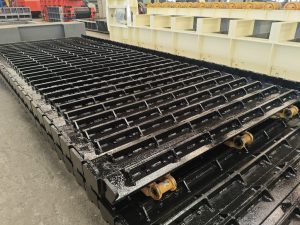
The steel pans are designed to overlap so that fine material does not easily leak through the carrying surface. Beneath them, the frame, rollers, and chain system distribute the load across the machine structure.
For very large ore or rock, proper hopper design is critical. The feeder is not working alone; the hopper slope, skirt boards, impact zone, and loading height all affect performance. A well-designed apron feeder system reduces dead zones, prevents bridging, and avoids uncontrolled surges.
Step 2: Carrying Abrasive, Hot, and Oversized Materials
A key advantage of the heavy duty apron feeder is its ability to handle materials that would quickly damage rubber belts. Sharp copper ore, iron ore, limestone, bauxite, coal, hot clinker, and recycled slag can all create severe wear.
Steel pans provide resistance against cutting and tearing. In hot applications, the feeder can be specified with materials and components suitable for elevated temperatures. For oversized material, the rigid pan surface and chain-driven movement allow the feeder to move large lumps without sudden belt damage.
This makes apron feeders especially valuable in:
- Primary crushing stations
- Underground mine haulage systems
- Cement plant limestone handling
- Coal preparation plants
- Metallurgical sinter and clinker lines
- Quarry and aggregate production
- Mineral processing plants
Step 3: Using Chain Power to Move Heavy Loads
The heart of apron feeder operation is the chain and sprocket system. Instead of relying on belt friction, the feeder uses positive mechanical engagement. The drive sprocket pulls the chains, and the chains move the pans forward.
This design gives the feeder high tractive force at low speed. That matters because heavy material is often difficult to start after a stop, especially when the hopper above the feeder is full.
A properly selected heavy duty apron feeder drive must provide enough starting torque, continuous torque, and speed control. Hydraulic drives are common in tough applications because they offer smooth starts and strong overload protection. Variable frequency drives are also widely used where electric control and plant automation are priorities.
Step 4: Controlling Feed Rate With Variable Speed
One of the most important functions of a variable speed apron feeder is flow control. By adjusting feeder speed, operators can regulate the amount of material delivered to downstream equipment.
This is essential because crushers, screens, conveyors, and mills perform best when the feed is steady. Too much material can overload the crusher. Too little material reduces plant efficiency. Uneven feeding causes power spikes, blockages, and wear imbalance.
Variable speed control allows the apron feeder to respond to:
- Changes in ore density
- Different lump sizes
- Moisture variation
- Crusher power demand
- Conveyor capacity limits
- Production rate targets
In high-ton-per-hour applications, this control is not a luxury. It is a requirement for stable plant performance.
Step 5: Discharging Material to Downstream Equipment
At the discharge end, the apron feeder transfers material to the next stage of the process. This may be a jaw crusher, impact crusher, mineral sizer, roller screen, belt conveyor, or mill feed chute.
Good discharge design reduces spillage, dust, and uneven flow. The discharge trajectory, chute angle, liner selection, and receiving equipment position all affect how smoothly material moves forward.
For abrasive material, chute liners may use wear-resistant steel, ceramic, or rubber depending on impact and sliding conditions. For sticky material, the discharge zone may require special geometry to reduce buildup.
High-Ton-Per-Hour Performance Depends on System Design
A heavy duty apron feeder can support extremely high throughput, but capacity is not defined by feeder size alone. Real production depends on the complete system.
Important design factors include:
- Material bulk density
- Maximum lump size
- Required feed rate
- Hopper pressure
- Pan width and speed
- Chain strength
- Drive torque
- Installation angle
- Duty cycle
- Downstream equipment capacity
A feeder designed for limestone may not be suitable for hot clinker. A feeder used under a truck dump station may need heavier impact protection than one installed under a controlled bin. The best results come from matching the feeder to the actual operating conditions, not simply selecting from a catalog.
Maintenance Practices That Protect Reliability
In heavy industry, uptime is often the real measure of equipment quality. A well-built apron feeder for mining should be designed for access, inspection, and long service life.
Key maintenance points include:
- Checking chain tension regularly
- Inspecting pan bolts and wear surfaces
- Monitoring roller condition
- Lubricating bearings as specified
- Checking sprocket wear
- Watching for abnormal noise or vibration
- Keeping the discharge area clean
- Verifying drive temperature and pressure
Many failures begin as small alignment, lubrication, or tension problems. Routine inspection prevents these issues from becoming unplanned shutdowns.
Why Heavy Duty Apron Feeders Remain Essential
Modern processing plants demand higher capacity, better automation, and lower downtime. Yet the basic challenge remains the same: raw material is heavy, irregular, and often unforgiving.
The heavy duty apron feeder solves this challenge by combining impact resistance, controlled movement, high torque, and durable construction. It protects crushers, stabilizes plant flow, and allows operators to manage difficult materials with confidence.
From the first impact under the hopper to the final controlled discharge, the apron feeder is more than a conveyor. It is the mechanical buffer between unpredictable raw material and precision processing equipment.
For mines, cement plants, quarries, coal yards, and metallurgical operations, choosing the right apron feeder is not just an equipment decision. It is a production reliability decision.
FAQ
A heavy duty apron feeder uses overlapping steel pans, strong chains, support rollers, and a reinforced frame to absorb and distribute impact from falling rock, ore, coal, or clinker.
A heavy duty apron feeder is better suited for abrasive materials because its steel pan construction resists cutting, tearing, and puncture better than standard belt feeding equipment.
Yes. A heavy duty apron feeder can use hydraulic drives or variable frequency electric drives to adjust speed and control the feed rate to crushers, screens, conveyors, or mills.
Heavy duty apron feeder equipment is widely used in mining, coal handling, cement production, quarrying, metallurgy, aggregate processing, and mineral processing plants.
A heavy duty apron feeder should be maintained through regular chain tension checks, roller inspection, lubrication, pan wear monitoring, sprocket inspection, and drive system checks.