
The apron feeder market surge is not a story about one machine suddenly becoming fashionable. It reflects a harder operational reality across mining, coal preparation, quarrying, and cement: plants are expected to move more raw material, tolerate more variable feed, and lose fewer hours to the receiving end of the process.
That is where a heavy-duty apron feeder earns its place. Positioned beneath a dump hopper, stockpile, or ROM bin, it takes the first impact of large, abrasive, wet, or uneven material and delivers a controlled feed to the next stage. When that feed is unstable, the effect travels downstream quickly: crusher loading becomes erratic, spillage increases, operators intervene more often, and production targets become harder to protect.
For ZhenYuan, this market shift confirms a principle long understood by plant engineers: a feeder is not a simple transfer device. It is a production-control machine at the point where the toughest material first meets the process.
Why Is the Apron Feeder Market Growing?
The demand behind the apron feeder market surge comes from a combination of capacity expansion, mine life extension, and a more disciplined approach to uptime. New mineral projects need dependable front-end handling systems, while established operations are upgrading bottlenecks around hoppers, crushers, and reclaim stations. Coal operations face a similar challenge when raw coal contains oversize lumps, moisture, clay, or sharp fluctuations in feed rate.
The wider minerals sector is also under pressure to develop and handle more strategic raw materials. This has placed greater value on equipment that can accept difficult feed conditions without compromising downstream control. In these applications, the comparison is not simply between one feeder and another. It is between stable plant operation and repeated disruptions at the most exposed point in the material flow.
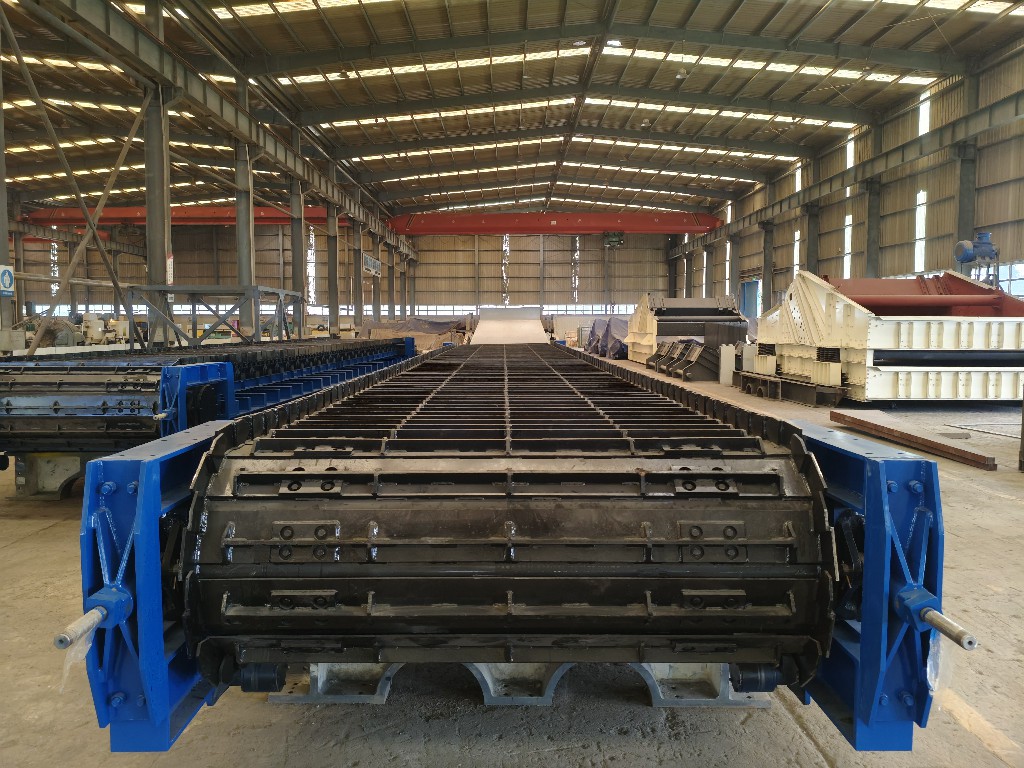
Unlike lighter feeders, an apron feeder uses overlapping steel pans carried by chains, sprockets, rollers, and a robust frame. This construction allows it to absorb direct loading and convey large lumps at low, controllable speeds. A properly specified mining apron feeder can meter ROM ore to a primary crusher, reclaim material from a stockpile, or regulate flow beneath a coarse ore bin without relying on a smooth, uniform feed.
The Real Value of a Heavy-Duty Apron Feeder
High capacity alone does not define a capable apron feeder. A feeder rated for the same nominal tonnes per hour can perform very differently when the material changes from dry limestone to wet coal, or from well-sized aggregate to blasted copper ore. The correct design begins with the duty, not a catalogue number.
Experienced engineering teams evaluate the full loading case: maximum lump size, bulk density, moisture and clay content, abrasiveness, hopper geometry, expected head load, required throughput, and the duty cycle of the downstream crusher. These details affect pan width, chain pitch, roller arrangement, drive torque, installed power, and the speed-control range.
Consider two plants that each require 1,000 tonnes per hour. One may handle free-flowing crushed stone from a shallow bin. The other may receive high-impact, oversized ROM material under a tall hopper. Their feeders should not be identical. The second application may need a stronger pan profile, a heavier chain and support system, higher starting torque, and additional attention to impact zones and service access. That is why the most credible apron feeder manufacturers ask questions before they propose a model.
From Purchase Price to Lifecycle Control
The market is moving beyond the idea that the lowest initial equipment price produces the best value. In a primary crushing circuit, an unplanned feeder stoppage can interrupt the entire line. Buyers are increasingly evaluating the lifetime consequences of selection: wear life, access for inspection, spare-parts strategy, drive reliability, chain adjustment, and how readily the feeder can be maintained during planned shutdowns.
This is especially important for coal apron feeder applications. Coal may appear less abrasive than hard rock, but wet, sticky feed can create its own problems. Build-up, uneven loading, and uncontrolled discharge can reduce effective capacity and complicate crusher operation. Variable speed control gives the operator a practical way to match feed delivery to downstream conditions instead of running the equipment at one fixed rate.
The same thinking applies to mining apron feeder projects. Modern sites want evidence that a design can accommodate actual operating conditions, including seasonal changes, material variability, and future production adjustments. A feeder should support the process, not become the process limitation.
How ZhenYuan Approaches Apron Feeder Engineering
ZhenYuan develops heavy-duty apron feeder solutions around the material path and the operating duty. Before configuration, the engineering review considers the material description, feed size distribution, capacity target, hopper or bin arrangement, discharge interface, downstream equipment, and site conditions. This helps define an apron feeder that fits the circuit rather than a standard machine forced into an unfamiliar role.
Depending on the application, a ZhenYuan apron feeder can be configured with durable steel pans, a robust chain-and-roller running system, matched drive components, and speed control suited to the required feed range. The intent is straightforward: maintain controlled material delivery while allowing maintenance teams reasonable access to serviceable components.
This approach is valuable in new installations and in brownfield upgrades. When replacing an existing plate feeder, the physical envelope is only one part of the equation. The new machine must also align with loading conditions, support structure, discharge elevation, crusher acceptance, electrical controls, and maintenance practices. A thoughtful review at the selection stage prevents expensive compromises once the feeder is in service.
What Buyers Should Ask Before Selecting an Apron Feeder
The strongest procurement decisions are built on operating data. Before choosing a heavy-duty apron feeder, ask these questions:
- What are the maximum, average, and fines fractions of the feed material?
- Will material be dumped directly onto the pans, and what impact energy must the feeder absorb?
- What are the normal and peak capacity requirements in tonnes per hour?
- Is the material dry and free-flowing, or wet, sticky, abrasive, or prone to bridging?
- Which crusher, conveyor, screen, or transfer point receives the discharged material?
- What level of access is required for routine inspection, chain adjustment, lubrication, and wear-part replacement?
Clear answers lead to a more reliable specification. They also make supplier comparisons fairer, because buyers can compare design assumptions rather than only comparing headline capacity figures.
The Next Phase of the Apron Feeder Market Surge
The next stage of growth will favor equipment that makes production more predictable. The market will continue to reward robust mechanical design, but it will also place greater emphasis on controllable speed, condition monitoring, serviceability, and integration with the wider crushing and conveying system.
For plant owners, the practical takeaway is simple. An apron feeder deserves the same engineering attention as the crusher it feeds. The best solution is not the biggest machine or the lowest quoted price. It is the machine whose pans, chains, drive, support structure, and controls are matched to the real material and operating duty.
ZhenYuan supports mining, coal, and bulk material projects with apron feeder engineering that starts with those realities. Whether the requirement is controlled ROM feeding, stockpile reclaim, or an upgrade to a constrained crushing line, the right feeder design can turn a difficult first transfer into a stable foundation for the whole process.
FAQ
An apron feeder is a heavy-duty mechanical feeder used to receive, convey, and meter bulk material at a controlled rate. Mining apron feeder systems commonly feed primary crushers or reclaim ROM ore from bins and stockpiles. Coal apron feeder systems are often selected where raw coal is heavy, wet, lumpy, or subject to direct loading.
Apron feeder capacity depends on pan width, bed depth, feeder speed, bulk density, and the material's flow behavior. A reliable calculation also checks the maximum lump size, hopper head load, inclination, and the downstream equipment's acceptance capacity. Nominal tonnes per hour should always be verified against the actual loading condition.
An apron feeder uses steel pans and a chain-driven running system, making it suitable for high-impact, abrasive, oversized, or hot material. A belt feeder is generally better suited to lighter, more consistent material where direct impact and large lumps are limited. The correct choice depends on duty conditions, not just throughput.
Variable speed control allows a coal apron feeder to regulate delivery when feed moisture, lump size, or downstream crusher load changes. It can help reduce surging, avoid overfeeding, and give operators better control of the coal handling circuit.
To size a ZhenYuan apron feeder, provide the material name, bulk density, maximum and average lump size, moisture or stickiness, normal and peak capacity, hopper arrangement, discharge height, downstream equipment details, operating hours, and available installation space. Photos, layout drawings, and material samples can further improve the selection accuracy.