

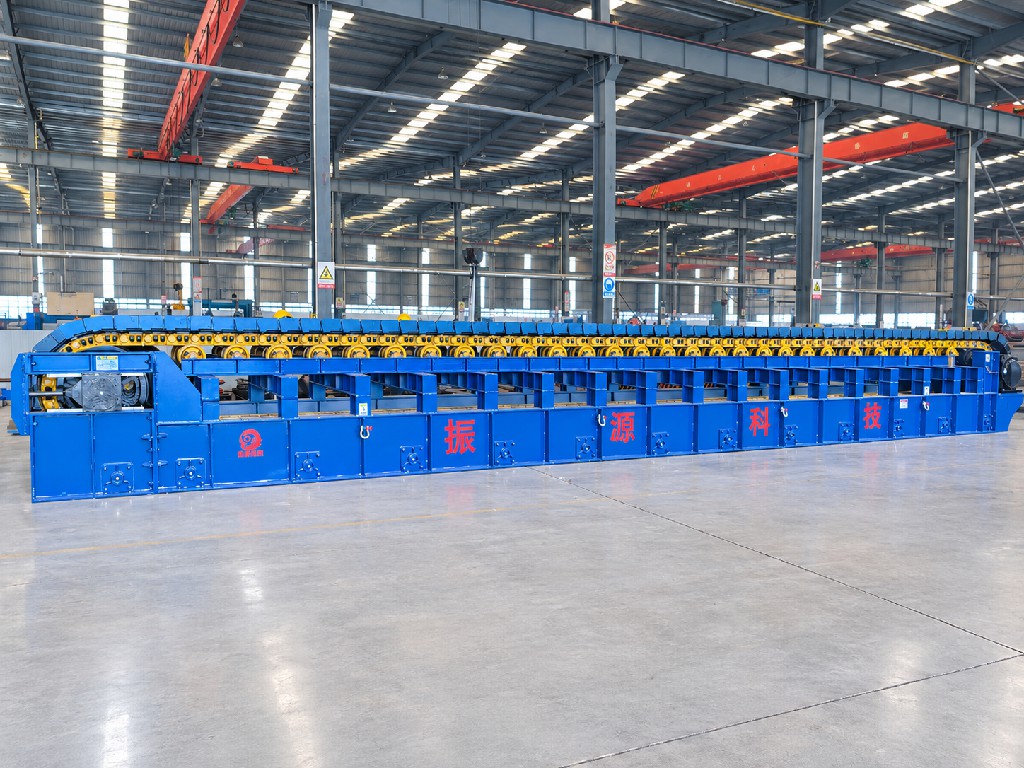
An Apron Feeder may appear late on a procurement list, yet it sets the pace for the plant that follows. When it is undersized, a primary crusher starves, surges, or takes damaging overloads. When it is oversized in the wrong way, the project pays for extra steel, power, and maintenance without gaining availability. The answer is not to begin with a catalogue model. Begin with the material leaving the hopper and the production duty the plant must sustain.
For mining, quarrying, cement, and coal handling, an Apron Feeder receives high-impact, coarse, abrasive, or sticky material and releases it at a controlled rate. Procurement becomes more reliable when five field facts are translated into equipment duty: particle size, bulk density, throughput, hopper geometry, and operating conditions.
Start with the duty, not the model number
A quotation for a “1,000 t/h Apron Feeder” is incomplete. One thousand tonnes per hour of fine, free-flowing limestone is a very different duty from 1,000 tonnes per hour of wet, blast-run copper ore. The second case can impose greater impact, extraction resistance, lump clearance, and starting torque—even with the same nameplate capacity.
State normal, peak, and minimum rates in the request for quotation. Normal capacity defines the production target; peak capacity covers truck tipping or uneven reclaim; minimum capacity protects a crusher, screen, or conveyor at reduced feed. Identify operating hours, starts per hour, and whether the feeder must start under a loaded hopper. These facts affect mechanical design and the drive.
Turn ore size into feeder geometry
Top size governs more than pan width. It affects the hopper outlet, skirt clearance, impact zone, chain loading, and bridging risk. Send the actual maximum lump size (P100 or measured top size), a typical coarse fraction such as P80, particle shape, and a representative gradation. Slabby or elongated rock does not move like rounded fragments, while a high fines content changes how material compacts beneath the hopper.
Use width as a screening decision, not a shortcut. A common preliminary practice is to allow a width near twice the largest expected lump, then validate it against the hopper opening, material shape, and side clearance. Two large lumps can wedge across a narrow opening and stop the plant. Pan and skirt widths must therefore pass both a capacity check and a lump-flow check; the larger practical requirement controls.
Loading method matters too. Direct truck dumping is a severe impact case; stockpile reclaim is more uniform; an underground ore pass may bring intermittent oversize and variable moisture. Specify the heavy-duty Apron Feeder for the loading method, not simply for the material name.
Convert tonnes per hour into a realistic Apron Feeder capacity
Apron Feeders meter a moving volume of material. For a preliminary estimate:
Capacity (t/h) = 3.6 × A × v × ρb × k
A is effective material cross-section in m², v is pan speed in m/s, ρb is loose bulk density in t/m³, and k represents usable fill. This is a starting point, not a substitute for supplier force and power calculations.
Use loose bulk density, not particle or solid density. Low density may require more speed to reach the target tonnage, while the highest credible density generally drives extraction force and torque. Record density as a range where blending, moisture, or coal quality varies. Confirm that the selected speed range meets both minimum controlled feed and peak rate without leaving stable drive operation.
Do not solve a capacity issue merely by increasing speed. Faster pans can accelerate wear, disturb the feed pattern, and overload receiving equipment. A sound selection balances bed depth, feeder width, and controllable speed so the crusher sees an even burden rather than slugs.
Treat the hopper–feeder interface as a design input
The most commonly missed dimension is the hopper shear length at the skirt line: the effective length of material that the Apron Feeder extracts from beneath the hopper, not the visible top opening. It strongly influences extraction resistance and drive torque.
Provide a layout drawing showing hopper outlet, chute, feeder elevation, discharge point, and maintenance clearances. Include bed depth, drop height, and wall or liner arrangement. Excessive drop height accelerates pan and liner wear; too little retained bed depth concentrates impact. Good loading spreads the load across the pans rather than holding a permanent pile against one skirt.
Match the drive to actual resistance
Motor power alone does not prove that an Apron Feeder is correctly selected. The drive must handle running resistance, loaded start-up, hopper extraction, incline, friction, and the supplier’s defined design margin. Gear ratio, drive sprockets, chain pull, backstop needs, and controls all matter.
Variable speed is valuable when material properties or downstream demand change. A VFD-controlled electromechanical drive offers measured adjustment; hydraulic drives can suit applications requiring their particular control and start characteristics. Select by required speed range, starts, ambient conditions, electrical supply, and maintenance strategy. Ask suppliers to state maximum and continuous torque—not only installed kilowatts—and to confirm lowest-speed performance.
Specify construction for wear, impact, and clean-out
An Apron Feeder is a structural machine as well as a metering device. Its pans, chains, rollers, sprockets, frame, and bearings must suit the worst credible material condition. Large abrasive ore needs robust pans and a well-supported impact zone. Wet coal or clay-bearing ore requires attention to skirt sealing, buildup control, drainage, clean-out access, and transfer-chute geometry. In both cases, plan for spillage under the feeder.
Request the pan profile and wear material, chain or track configuration, roller spacing, lubrication approach, guarding, and inspection access. A design that makes roller replacement or liner change-out difficult can create costly downtime long after commissioning.
Check the whole flow path
The feeder must deliver a consistent bed to the receiving crusher, screen, or conveyor. Confirm discharge opening, chute angle, receiving-equipment capacity, and how uncontrolled flow is prevented when the feeder stops. Feeder length is not just a transport distance; it must supply the extraction zone and discharge arrangement without avoidable transfer points. An incline can reduce layout length, but it also changes forces, containment, and maintenance access.
Build an RFQ that produces comparable offers
A concise application data sheet should contain:
- Material name, abrasiveness, moisture range, temperature, and sticky or corrosive behaviour.
- P100/top size, P80, gradation, particle shape, and loose bulk-density range.
- Normal, peak, and minimum t/h; operating hours; and start-stop duty.
- Hopper drawings with outlet size, shear length, bed depth, drop height, and loading method.
- Inclination, discharge destination, footprint, elevation, ambient conditions, and power supply.
- Required controls, speed range, guards, spares, service expectations, and acceptance tests.
Ask each supplier to declare its design assumptions and exclusions. It quickly reveals whether offers are genuinely comparable.
Purchase for reliable tonnes, not nominal tonnes
Before award, review the general arrangement, duty calculation, drive torque curve, component list, and wear-part plan with operations and maintenance teams. At factory acceptance or pre-delivery review, confirm dimensions, speed range, guarding, lubrication, instrumentation, and documentation. Secure commissioning spares for critical pans, rollers, chains, sprockets, and liners.
The best Apron Feeder is not necessarily the biggest or the lowest-priced. It is the machine whose width, extraction zone, drive torque, wear design, and controls match the ore and the plant’s operating envelope. Make that match before purchase, and the feeder becomes a foundation for throughput instead of a bottleneck everyone notices too late.
Frequently Asked Questions
No universal width can be set from “600 mm” alone. Start with the actual top-size distribution and the most awkward lump shape, then check hopper-opening clearance and bridging potential. A preliminary rule may place width around twice the largest lump, but final Apron Feeder width must be confirmed against hopper geometry, side skirts, bed depth, and capacity.
Apron Feeder capacity depends on effective material cross-section, pan speed, loose bulk density, and usable fill. Give the supplier normal, peak, and minimum throughput plus density ranges. It should demonstrate that speed, torque, and the motor-reducer meet every operating case, not merely normal rate.
A mining Apron Feeder benefits from variable speed when density, moisture, blend, truck-dump pattern, or crusher demand varies. It enables controlled adjustment without changing the machine, provided the drive supplies enough low-speed torque and can start under load.
Yes—if the complete loading and discharge arrangement is designed for it. Specify appropriate pan and skirt details, clean-out provisions, drainage where needed, accessible liners, and a chute without stagnant pockets. State maximum moisture and fines in the RFQ.